Gambling vs. Investing

Originally published in the Brandywine Asset Management Monthly Report.

Brandywine is well known for the diversity of trading strategies we have developed over the past 30+ years and continue to employ today in Brandywine’s Symphony program. It is this strategy diversity that provides us with the opportunity to profit across a variety of market conditions and, although past performance is not predictive of future performance, to increase the probability that future returns will approximate past returns.

While Brandywine’s specific trading strategies and portfolio allocation model (which determines the allocation to be made to each trading strategy and market in the portfolio) is somewhat complex, the underlying concept upon which we base our investment philosophy is quite simple. That is, we create a portfolio that is balanced across a wide range of trading strategies, each based on a sound, logical return driver capable of providing positive returns over time. Properly employed, this approach will create a portfolio that produces greater returns with less risk than a less-diversified portfolio.

To illustrate this let’s look at a simple example using two actual trading strategies.

The first strategy is a “tail-risk” strategy designed to perform especially well during periods of financial and commodity market disruption. It has produced the following risk-return profile since the end of 1998 (the end of trading in Brandywine’s Benchmark program and the start of the simulations for Brandywine’s Symphony program [1]).

Annualized Return: 5.0%
Annualized Volatility: 23.3%
Maximum Drawdown: -44.2%
Return-to-Vol Percentage: 21%

The second strategy, in contrast to the first strategy, benefits from favorable financial market conditions.

Annualized Return: 3.7%
Annualized Volatility: 15.7%
Maximum Drawdown: -51.0%
Return-to-Vol Percentage: 24%

No one in their right mind would employ either of these two strategies as a standalone strategy in their portfolio; they’re too risky. To receive single-digit returns while risking half your money is akin to gambling. But each strategy is based on a reasonably sound return driver that would permit it to be allocated a small part (perhaps a few percent) of a portfolio. And because those return drivers are truly independent of each other, allowing one strategy to profit while the other is losing, by combining the two we get the following, much more favorable, performance:

Annualized Return: 10.3%
Annualized Volatility: 22.5%
Maximum Drawdown: -27.9%
Return-to-Vol Percentage: 45%

The tremendous benefits of “true” portfolio diversification can already begin to be seen with just these two truly independent trading strategies combined into a balanced portfolio. The annualized return of the two-strategy portfolio is more than twice as good as that of the best-performing strategy and with just half its volatility. The maximum drawdown is also significantly lower than that of either of the two strategies.

Now multiply this effect by the dozens of trading strategies incorporated into Brandywine’s Symphony program and you can understand how we achieve the ACTUAL performance results shown in these reports – where the risk-adjusted return is five times better than the average of the two strategies.

We understand that not everyone can replicate what Brandywine has built over its 30-year history. But what we can’t understand is why people would choose to gamble with their money. We say that because the second strategy shown in the above example is actually the S&P 500 total return index. Yes, the strategy that no one in their right mind would employ as a standalone strategy is the dominant strategy employed by most people in their portfolios!

Portfolio diversification is often preached but virtually never employed. Concentrating a portfolio in stocks (as well as stocks and bonds, but that’s the subject of another article) is not investing, it’s gambling. In addition to the tremendous benefits of true portfolio diversification, what this simple example shows is that the vast majority of people have been taught to gamble with their money. Instead of investing – by truly diversifying their portfolios to earn better returns with far less risk than they are taking – they choose to let substantial portions of their portfolios ride on one highly risky bet. Even if you think stocks are a good buy, why wouldn’t you find other opportunities to diversify your portfolio and reduce risk? As Brandywine has discovered, there are dozens of equally or even more compelling trading strategies that can be employed in your portfolio.

Don’t gamble – invest.

(1) Since the performance of the first strategy shown in these examples is based on back-tested (hypothetical) performance, the following disclaimer is required:

HYPOTHETICAL PERFORMANCE RESULTS HAVE MANY INHERENT LIMITATIONS, SOME OF WHICH ARE DESCRIBED BELOW. NO REPRESENTATION IS BEING MADE THAT ANY ACCOUNT WILL OR IS LIKELY TO ACHIEVE PROFITS OR LOSSES SIMILAR TO THOSE SHOWN. IN FACT, THERE ARE FREQUENTLY SHARP DIFFERENCES BETWEEN HYPOTHETICAL PERFORMANCE RESULTS AND THE ACTUAL RESULTS ACHIEVED BY ANY PARTICULAR TRADING PROGRAM.

ONE OF THE LIMITATIONS OF HYPOTHETICAL PERFORMANCE RESULTS IS THAT THEY ARE GENERALLY PREPARED WITH THE BENEFIT OF HINDSIGHT. IN ADDITION, HYPOTHETICAL TRADING DOES NOT INVOLVE FINANCIAL RISK, AND NO HYPOTHETICAL TRADING RECORD CAN COMPLETELY ACCOUNT FOR THE IMPACT OF FINANCIAL RISK IN ACTUAL TRADING. FOR EXAMPLE, THE ABILITY TO WITHSTAND LOSSES OR TO ADHERE TO A PARTICULAR TRADING PROGRAM IN SPITE OF TRADING LOSSES ARE MATERIAL POINTS WHICH CAN ALSO ADVERSELY AFFECT ACTUAL TRADING RESULTS. THERE ARE NUMEROUS OTHER FACTORS RELATED TO THE MARKETS IN GENERAL OR TO THE IMPLEMENTATION OF ANY SPECIFIC TRADING PROGRAM WHICH CANNOT BE FULLY ACCOUNTED FOR IN THE PREPARATION OF HYPOTHETICAL PERFORMANCE RESULTS AND ALL OF WHICH CAN ADVERSELY AFFECT ACTUAL TRADING RESULTS.

Share this post:
  • Facebook
  • Twitter
  • email
Permalink

Gambling on Stocks vs. Investing with “True” Portfolio Diversification

Originally published in the Brandywine Asset Management Monthly Report.

The vast majority of people do not maintain diversified investment portfolios. This is not necessarily their fault. They have been taught, through the popular press and by financial “professionals,” to gamble with their money. This is evidenced by the fact that when stocks and bonds rise in value, most people’s portfolios also rise in value. This shows, all by itself, that their portfolios are undiversified – a single “return driver” dominates their portfolios’ performances (as discussed in last month’s report here). As Mike Dever states in the chapter on gambling, investing and trading in his best seller, “If you are acutely aware of every fluctuation in the U.S. stock market, then you certainly have too much riding on the outcome. You are gambling.” Many financial advisors try to overcome this unfortunate situation by preaching to their clients to disregard such fluctuations and “invest for the long run.” But this doesn’t reduce the risk, it merely ignores it! If investing were a fantasy, this might make sense. (“Pay no attention to that man behind the curtain”). But it is very real, and risk must be dealt with head on.

There are two primary reasons people continue to be taught to gamble with their money. The first is based on an erroneous definition of risk. Often without even being aware of it, most people equate different with risky. Since ‘everyone’ preaches and holds portfolios dominated by stocks and bonds, it is considered risky to do something different. If you are an institutional investor whose performance is benchmarked to the S&P 500, there is career risk in deviating substantially from that index. Also, because individuals are often so fixated on the stock market, many financial advisors risk (there’s that word again) being fired by their clients if their portfolios underperform the major stock indexes. Rather than educate those clients on the benefits of true portfolio diversification versus gambling their money, they take the easier path of risking their clients’ portfolios rather than their own financial security. But for the vast majority of individuals, career risk is the wrong definition of risk. Their risk is defined by their probability of falling short of their required financial goals, such as funding a college account for their children or creating a nest-egg for retirement. Employing true portfolio diversification lowers that risk.

The second reason people continue to be taught to gamble is ignorance. Many financial professionals are not aware of the options available to diversify their clients’ portfolios. Virtually all the major financial publications, Internet web sites, TV broadcasts or certification programs define investing as buying stocks and bonds. There is an occasional mention of “alternatives” but the name itself suggests these are ‘optional’ investment opportunities—certainly not primary.

But there is one primary way to reduce portfolio risk, which is to employ “true” portfolio diversification. Brandywine does this by diversifying across dozens of return drivers and more than 100 global financial and commodity markets. The results are significant and can be seen in the stability of returns over time. Let’s take a look.

As Mike Dever points out in myth #9 of his book, “Risk Can be Measured Statistically,” volatility is a very poor measure of risk and in itself can be very volatile. This is a drawback of the Sharpe ratio – a common performance measure – which equates volatility with risk. But what is interesting is that by measuring, over longer time periods, the volatility of the Sharpe ratio, you can start to see the true risk underlying a portfolio. That is because portfolios dependent on just a few return drivers will eventually suffer significant losses when those return drivers fail to perform. This is exactly what is apparent in the chart below, which tracks the rolling 3-year Sharpe ratio for the S&P 500 and the tested performance(1) of Brandywine’s Symphony program from 2002 through June 2011. As can be seen in the chart, the Sharpe ratio for the S&P 500 varied considerably over the period while that for Brandywine’s Symphony program remained relatively stable.

This performance stability continued after the start of actual trading in Brandywine’s Symphony program in July 2011. Since that time the Sharpe ratio for Brandywine’s Symphony program, currently at 1.15, has hovered near its long-term average. On the other hand, despite the historic rally in the S&P 500 over the past few years, and the fact that its current Sharpe ratio (at 0.89) is well above its longer-term average, that value is still quite a bit below that of Brandywine’s Symphony program. This is not unexpected and provides further evidence of the global diversification value provided by an investment with Brandywine. The result is true portfolio diversification, which provides greater returns with less risk than the S&P 500.

(1) HYPOTHETICAL PERFORMANCE RESULTS HAVE MANY INHERENT LIMITATIONS, SOME OF WHICH ARE DESCRIBED BELOW. NO REPRESENTATION IS BEING MADE THAT ANY ACCOUNT WILL OR IS LIKELY TO ACHIEVE PROFITS OR LOSSES SIMILAR TO THOSE SHOWN. IN FACT, THERE ARE FREQUENTLY SHARP DIFFERENCES BETWEEN HYPOTHETICAL PERFORMANCE RESULTS AND THE ACTUAL RESULTS ACHIEVED BY ANY PARTICULAR TRADING PROGRAM.

ONE OF THE LIMITATIONS OF HYPOTHETICAL PERFORMANCE RESULTS IS THAT THEY ARE GENERALLY PREPARED WITH THE BENEFIT OF HINDSIGHT. IN ADDITION, HYPOTHETICAL TRADING DOES NOT INVOLVE FINANCIAL RISK, AND NO HYPOTHETICAL TRADING RECORD CAN COMPLETELY ACCOUNT FOR THE IMPACT OF FINANCIAL RISK IN ACTUAL TRADING. FOR EXAMPLE, THE ABILITY TO WITHSTAND LOSSES OR TO ADHERE TO A PARTICULAR TRADING PROGRAM IN SPITE OF TRADING LOSSES ARE MATERIAL POINTS WHICH CAN ALSO ADVERSELY AFFECT ACTUAL TRADING RESULTS. THERE ARE NUMEROUS OTHER FACTORS RELATED TO THE MARKETS IN GENERAL OR TO THE IMPLEMENTATION OF ANY SPECIFIC TRADING PROGRAM WHICH CANNOT BE FULLY ACCOUNTED FOR IN THE PREPARATION OF HYPOTHETICAL PERFORMANCE RESULTS AND ALL OF WHICH CAN ADVERSELY AFFECT ACTUAL TRADING RESULTS.

Share this post:
  • Facebook
  • Twitter
  • email
Permalink

Brandywine vs. S&P 500

Originally published in the Brandywine Asset Management Monthly Report.

You see that in these reports we compare our performance to both the BTOP50 CTA index and the S&P 500 Total Return index (which includes dividends). While it may make some sense for us to compare ourselves to other CTAs (after all, we are a CTA), we provide the comparison to the S&P 500 TR index not because there’s any relevance to the comparison, but because it is expected of us (investors seem to compare every investment to the S&P 500). In reality, however, it’s really neither sensible nor fair for us to compare our performance to the S&P 500.

It’s not sensible because the S&P 500, despite the “500” in its name, is a narrowly focused index, whose returns are powered by a limited number of “return drivers.” Mike Dever explains this (and discusses return drivers) at length throughout his best-seller, Jackass Investing: Don’t do it. Profit from it. In particular, in the opening chapter of his book, he shows how the S&P 500 index price is dominated by two primary return drivers. In the short-term, defined as less than 20 years (which for most people would be considered long-term), it is driven by changes in people’s enthusiasm for owning stocks. Longer-term, growth in corporate earnings is the dominant return driver. In stark contrast, Brandywine’s performance is driven by dozens of return drivers acting across more than 100 global financial and commodity markets.

It is this stark difference in the diversification between the S&P 500 TR index and Brandywine’s Symphony program that also makes a comparison of the two unfair. Over time, the S&P 500 TR index will be unable to compete on a risk-adjusted basis with the returns earned by Brandywine. This is already becoming apparent. While past performance is not necessarily indicative of future performance, since the inception of Brandywine’s Symphony program in July 2011, both the program and the aggressively-traded Brandywine Symphony Preferred Fund have produced risk-adjusted returns that exceed those of the S&P 500. This is despite the fact that Brandywine has slightly underperformed expectations and the S&P 500 has produced strong returns (relative to its historical returns) over that period.

The basis for making the statement that the S&P 500 TR index will underperform Brandywine on a risk-adjusted basis is one of simple math. Brandywine’s Symphony program incorporates dozens of trading strategies that are each based on a sound, logical return driver capable of producing positive returns over time. While any single one of them may approximate the risk-return profile of the U.S. stock market (such as a 10% expected return with the probability of an occasional 50% drawdown), in combination they produce those returns with much reduced risk. As summarized in the final chapter of Mr. Dever’s book, this is due to the fact that the returns earned by any single trading strategy in Brandywine Symphony’s portfolio are unrelated to the returns earned by the other trading strategies. When one is losing, there is the potential that another is profiting.

This is the basic concept behind portfolio diversification and Modern Portfolio Theory. Unfortunately, the way MPT is taught and practiced by most people is not true investing; it’s gambling. That is because their portfolios may contain as much as 20%, 30% or even 60% long stock exposure. By creating portfolios that are dominated by long stock exposure, they are gambling their money on a single return driver (people’s enthusiasm for stocks). Brandywine’s Symphony program is also exposed to global stock markets, but as we practice ‘true’ portfolio diversification, this sector represents just 17% of the portfolio, and that portion is dynamically allocated both long and short among the stock indexes of dozens of countries. The remaining 83% of Brandywine’s portfolio is allocated to trading strategies taking positions in the currency, interest rate, metals, energy and agricultural commodity markets.

If, over time, many of these trading strategies have a positive return, then over time Brandywine’s Symphony program will produce those returns, but with substantially reduced risk. In fact, because Brandywine’s drawdowns are smaller than those of a less diversified portfolio (such as one dominated by long stock exposure), the return can actually be greater than the average return of each strategy, as the portfolio spends more time producing new profits, rather than recovering from past losses. This is how we are able to produce such high absolute returns (such as the 20%+ annualized returns of the Brandywine Symphony Preferred Fund) and risk-adjusted returns.

We find that many people allocate their money based on fear. Interestingly, the fear of missing out is often greater than the fear of losing. Because of the overwhelming focus on the “stock market,” many people fear missing out on its potential returns, when in fact they could actually exceed those returns, with less risk, by investing in a truly diversified portfolio.

Share this post:
  • Facebook
  • Twitter
  • email
Permalink

The Abuse of Correlation

Originally published in the Brandywine Asset Management Monthly Report.

Throughout the years, we have observed an abuse of the correlation statistic in selecting managers. People seem to forget that their goal is to find managers who, when combined with each other, will increase overall portfolio returns and decrease risk (especially event risk). They are looking at correlation in order to help them find such managers, since non-correlation may be an indication of this diversification value. But instead of focusing on the goal, people have become increasingly focused on the correlation metric, which often results in them missing their goal, which is (we’re repeating ourselves here) to find managers who will increase portfolio returns and decrease risk.

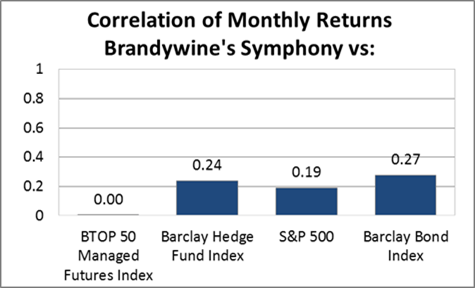
Brandywine’s Symphony program has a negative –0.06 correlation to the S&P 500, a 0.07 (non) correlation to the AlphaMetrix managed futures index and a low 0.34 correlation to the Barclay CTA index. Despite that, we occasionally hear analysts report to us that they find Brandywine Symphony’s performance to be “more correlated to trend followers” than they would expect, based on the fact that our portfolio is dominated by fundamentally-based, non-trend-following trading strategies (100% systematically applied). And that may be true. We don’t specifically structure our portfolio, as do some CTAs, to be un-or-negatively correlated. We just want to make money as consistently as possible with (this is the most important condition) a high probability that future performance will match past performance. Although the majority of our portfolio is fundamentally-based, we do have a 20% exposure to trend following. When trends occur, we want to be on the right side of them, and that does boost our correlation to trend followers in those trending periods (a GOOD thing!). But what really matters is not our correlation, but our value in achieving THE GOAL, which is to “increase portfolio returns and decrease risk.” Towards that goal we succeed completely.

One indication of this is that during Brandywine’s test period 1999 through June 2011, the BTOP 50 managed futures index suffered 18 drawdowns averaging -4.74%. During those periods Brandywine’s Symphony program GAINED +0.74% and our correlation with the index during those periods was a NEGATIVE 0.06. Furthermore, in keeping with the condition that past performance must be as predictive as possible of future performance, this characteristic holds up in actual trading. Since the launch of Brandywine’s Symphony program in July 2011, the BTOP 50 suffered a -5.21% drawdown. During that same drawdown period Brandywine’s Symphony program gained +5.74%.

So why is our correlation positive overall and should it be viewed as problematic?  Well, let’s ask a simple question. . . When the BTOP 50 is up, what would you prefer if you were invested with Brandywine’s Symphony?  Would you prefer we lose money to keep our correlation negative or would you prefer we make money, at the risk that someone misusing the correlation statistic might simply view an unparsed correlation number and think that embedded in the statistic was useful information?  The only reason (the “problem” if you will) that inflates our correlation statistic, is that we make money when the trend followers make money, even though most of what we do is driven by non-trend following trading strategies.

We would contend that as long as we make money when others are losing money (which we do) and are thus negatively correlated when trend-followers are losing money (which we are) then one should treat with great caution any statistic that would lead one to allocate less to Brandywine simply because we make money when others are also making money!

One way to see our value is to simply add Brandywine’s Symphony program to a portfolio and see the effect. We encourage you to present us with your portfolio. We will run a simple analysis that shows how that portfolio would perform with various allocations made to Brandywine’s Symphony. Because of the unique return drivers incorporated in Brandywine’s Symphony program, we are confident that the inclusion of Brandywine will both increase returns and decrease risk in your portfolio.

We look forward to talking with you soon.

Share this post:
  • Facebook
  • Twitter
  • email
Permalink

The Year in Review

Originally published in the Brandywine Asset Management Monthly Report.

2012 was the second consecutive losing year for the BTOP 50 managed futures index. This is the first back-to-back annual loss for the index since its inception 26 years ago. Systematic and diversified CTAs performed even worse than the broader index.

In contrast, Brandywine posted its second consecutive profitable year since the launch of Brandywine’s Symphony program in July 2011. So why has Brandywine – a systematic, diversified CTA – performed so well when our peers have not? The answer is rooted in our extensive history and unique investment philosophy.

Brandywine’s Innovations

Brandywine’s difference is not just one of performance, but one of design. Brandywine’s Symphony program was based on, and is the culmination of, the 30+ years of research and trading conducted by Brandywine since our founding in 1982. During that time Brandywine originated several approaches to managed futures trading and risk management.

In 1991 – at a time when traders were either “fundamental discretionary” or “systematic trend following” – we introduced fundamentally-based systematic trading in our Brandywine Benchmark program. At the same time, we innovated what today has become known as “risk-parity” portfolio modeling. This innovation, which bases portfolio allocation on balancing risk across a portfolio, was documented in a paper that was distributed by Brandywine to investors in the early 1990s. While the rest of the investment world has recently caught on to risk parity, they are still bound by the archaic concept of asset classes.

Brandywine recognized the limitations imposed by the use of asset classes, and so along with its development of risk parity modeling, Brandywine also introduced the concept of “return drivers.” This innovation (the use of return drivers) is discussed throughout Mike Dever’s book, Jackass Investing: Don’t do it. Profit from it., which was published in 2011 and remains an Amazon best-seller.

Brandywine’s Performance

The combination of multiple return driver based trading strategies that incorporate fundamentals in addition to technical factors, risk parity portfolio modeling, and diversification across more than 100 global markets (including financials and commodities), enabled Brandywine to consistently outperform its peers during the 1990s. Brandywine’s Symphony program is continuing this legacy of performance. This is evidenced not only by our positive performance, but by the fact that our current actual performance closely matches our expectations based on our actual past performance and updated testing. If you would like to discuss Brandywine’s investment philosophy, research innovations and performance in more detail, please contact Mike Dever or Rob Proctor, and we will schedule a call to discuss and answer your questions.

Best wishes for a successful New Year.

Share this post:
  • Facebook
  • Twitter
  • email
Permalink

Buying “Best of Breed”

Originally published in the Brandywine Asset Management Monthly Report.

Since the launch of Brandywine’s Symphony program in July 2011, the managed futures industry has undergone one of its more difficult performance patches. Over that period the Barclay 50 CTA index has dropped 3.1% and the systematic traders index has suffered a comparable decline. In contrast, Brandywine’s fundamentally-based, yet fully-systematic Symphony program has gained +6.83% and our aggressively-traded Brandywine Symphony Preferred Fund has gained +31.50%.

Brandywine’s positive divergent performance is the result of the diversified, fundamentally-based trading strategies incorporated in our fully-systematic trading model. Developed over the past 30 years, these strategies produce performance that is uncorrelated with traditional CTAs and the major financial indexes. We believe this recent performance, combined with our longevity and past performance, establishes Brandywine as best-of-breed among systematic CTAs and positions Brandywine among the top CTAs for consideration by both institutional and individual investors.

In addition, while Brandywine’s diverse trading strategies result in performance that is uncorrelated to the BTOP 50 during losing periods for the BTOP 50, our model is also able to exploit profit opportunities when market trends reassert themselves. The following two statistics clearly illustrate Brandywine’s favorable performance profile:

Brandywine Symphony’s correlation to BTOP 50 during Peak-to-Trough drawdowns in BTOP 50: -0.11
Brandywine Symphony’s correlation to BTOP 50 during recovery periods in BTOP 50: +0.46

So what the preceding statistics show is that Brandywine’s trading model is able to preserve profits during difficult market environments, such as the one we’ve been in since the start of trading in Brandywine’s Symphony program in July 2011, but also capitalize on market trends when they re-emerge.

Best-of-breed among investment managers is often defined by assets under management. The larger managers are considered better than the smaller managers. After all, they got large because they became accepted by more and larger investors. But larger does not mean better. In fact, as our CEO points out in his best-seller, “Jackass Investing: Don’t do it. Profit from it.,” there are a lot of investment opportunities available to smaller traders that are off-limits, precisely because of their size, to the largest managers. Furthermore, size does not ensure business continuity. In our 30 years of existence, Brandywine has seen the largest managers, through underperformance, become small again, or cease operations altogether.

That said, today the most significant allocations are being made to the largest CTAs. This is not unexpected. The largest investors want to invest in a fashion that is similar to their peers. They are comfortable putting money with the largest CTAs as their decision has been validated, with billions of dollars, by other investors. If their investment loses money, they are at less risk of losing their jobs than if they had invested with a less well-known and smaller manager.

But this is self-defeating behavior. The largest CTAs are fighting a headwind associated with their large size. There are a substantial number of return drivers they cannot exploit because of their size. Brandywine is aware of these limitations. In the 1990s, prior to a shift by our founder towards venture development investing, we were one of the largest CTAs. Our ongoing research at that time was not just focused on finding the best available trading strategies, but the best available trading strategies that could also be traded in substantial size. Since we became a “re-emerging” manager with the launch of our Brandywine Symphony program in July 2011, unencumbered by size, we have been able to re-focus our research effort on expanding our trading across a wide variety of return drivers. The benefit of this diversity shows in our performance.

Brandywine firmly believes that best-of-breed should be defined by the organization and performance. There was a time in the past when Brandywine was considered best-of-breed based partly on our level of assets under management. But even then we stressed that what differentiated us was more than our size; it was our organizational structure, history, investment philosophy and research approach. Those traits continue with Brandywine today and their virtuous effects are manifested in our performance.

Share this post:
  • Facebook
  • Twitter
  • email
Permalink

Hurricane Sandy and Business Continuity

Originally published in the Brandywine Asset Management Monthly Report.

Hurricane Sandy struck at the heart of the U.S. financial markets earlier this week, paralyzing New York City and the venerable New York Stock Exchange. Although “only” a category 1 storm, Sandy cast a wide swath, with tropical storm force winds extending for 1,000 miles. This led to a huge storm surge that wiped out entire shoreline communities in New York, New Jersey and Connecticut. The New York Stock Exchange closed for two days, the first consecutive daily closure due to weather since the “blizzard of 1888.”

Hurricane Sandy over New York City

New York Stock Exchange during the storm

Flooding at the height of the storm

The closure and disruption to financial markets highlighted the need for redundant systems and backup technology to prevent loss of operations caused by natural disasters and other factors. It also pointed out the significance of human factors that could cause business interruptions. The New York Stock Exchange was prepared to open on Monday and remain open throughout the storm, but that would have placed its employees in a dangerous situation. Despite its distributed technology and redundant infrastructure, the actual work of the exchange required people to be present at 11 Wall Street, and the breakdown of transportation and other risks were the primary factor in the decision to close the exchange.

Brandywine understands these risks quite well. Sixteen years ago we moved into our current offices, which are located in a 17th century grist mill in southeastern Pennsylvania (you can see photos of the Mill on brandywine.com). Like all mills, we are situated next to a stream, which for 250 years was used to power the water wheel. Fortunately, we are positioned near the headwaters of the stream, and even in the most severe storms to date (including Hurricanes Floyd, Irene and Sandy) rising waters fell far short of endangering our critical systems. While our operations may not have been directly impacted by a storm, our utility providers have been, resulting in loss of our primary power. Fortunately, we are also able to operate on our backup batteries (which provide uninterrupted power) and generator for extended periods. And we have back-up communications providers that are able to handle our telecommunications requirements in the event our primary phone/internet service fails. These systems serve as our first level of defense against business interruption.

Despite these precautions and redundancies, we are still at risk of a complete loss of our facilities here at the Mill and plan as if that is certain to occur. So as an additional level of backup, we operate a separate, autonomous office in Connecticut. This is staffed by one of Brandywine’s principals, Rob Proctor.

Notwithstanding this preparation and redundancies, we still realize there is a risk of interruption to our business. But in the event that does occur, and as part of our ‘belt-and-suspenders’ approach, all data is backed up daily to the “cloud.” This allows us to recover our business and restart operations as soon as one of our facilities is operational. In that event our loss will be limited to our opportunity costs during the time we were interrupted.

In Brandywine’s 30 years of business we have come to realize that although our primary risk is still related to our trading model and risk management, business continuity is also capable of negatively affecting our clients’ portfolios. Putting in place a sound, redundant infrastructure is an essential element in producing positive returns for our clients.

Share this post:
  • Facebook
  • Twitter
  • email
Permalink

Opportunity and the Control of Risk

Originally published in the Brandywine Asset Management Monthly Report.

Profit opportunities are not spread evenly over time. The key to successful trading is to capture profits when opportunities arise and to protect those profits when opportunities wane. This is illustrated by Brandywine’s historical performance.

The Brandywine Symphony program’s fundamentally-based (yet systematically-applied) trading strategies look for opportunities on a continuous basis. When the program launched in July 2011, many of Brandywine’s sentiment and event-based trading strategies recognized and captured opportunities that resulted from the stock market, currency and interest rate turmoil that dominated the second half of 2011. The result was a 6-month gain of +7.90% for Brandywine’s Symphony and +37.88% for the more aggressively-traded Brandywine Symphony Preferred Fund. This strong performance was especially beneficial to our investors due to the fact that both stock markets and other managed futures traders suffered losses over that same period.

Opportunities for Brandywine’s global trading strategies have been more limited during 2012. But Brandywine has responded well to this environment by preserving the profits earned during 2011. And not only has Brandywine preserved profits, but reduced volatility at the same time. This is exemplified by the fact that our average daily volatility over the past two months has fallen to just 2/3 of our longer-term average. This is also reflected in our decreased trading activity as our trading strategies wait for profit opportunities. (This is another characteristic that separates Brandywine from trend following managed futures traders, which tend to increase their trading frequency during losing periods, as their positions get “whip-sawed.”)

So where does that leave us now? One way to answer this question is to look at the historical tested performance of Brandywine’s Symphony program and estimate when the next set of profit opportunities are likely to appear. One way to measure this is to look at the average length of “quiet periods” such as the one we have been experiencing. Since 1999, the average quiet period has been 168 trading days. The current quiet period is in its 152nd day. While this doesn’t mean that we are on the brink of a new round of profits, it does put the current period in perspective.

A second way to view current opportunity is to compare Brandywine’s actual performance to its target performance. Brandywine’s Symphony program is targeting 12% annualized returns with an 8% annualized standard deviation. After performing above target from July 2011 through February of this year, the 3 month drawdown in March – May brought the performance to 7% below trendline. This is now in line with the 7.5% average of the 12 largest underperforming periods over the 12 year test period starting in 1999.

Brandywine’s aggressively-traded Symphony Preferred Fund targets returns and risk that are between 3x and 5x that of our standard Symphony program. As illustrated in the chart below, the Fund has performed below target since April. While we must state that PAST PERFORMANCE IS NOT NECESSARILY INDICATIVE OF FUTURE PERFORMANCE, research indicates that our current drawdown is once again entering the range in which to expect a rally.

Share this post:
  • Facebook
  • Twitter
  • email
Permalink

Is Past Performance Indicative of Future Performance?

Originally published in the Brandywine Asset Management Monthly Report.

Every investor is aware of the disclaimer that “PAST PERFORMANCE IS NOT NECESSARILY INDICATIVE OF FUTURE PERFORMANCE.” It is mandated by regulators to be written on all materials that contain performance information. At its basic level what this means is that you (and the people with whom you’re investing) CANNOT predict the future. Evidence of this abounds. As people have learned, just because John Paulson produced billions in profits from 2007-2010, that didn’t mean he’d produce the same result – or even profit at all – in 2011 or 2012. A primary reason for this unpredictability is that many investment managers and traders follow a singular or concentrated investment process or thesis. When that process or thesis is correct they profit. When it’s not, they suffer losses. They are not truly diversified.

Some people go so far as to interpret this observed unpredictability to mean that it is futile to try to pick winning investments. This belief has manifested itself in the drive for people to simply buy an index. But that action itself is based on the belief that the index will continue to perform in the future in a fashion consistent with how it performed in the past. The reality is that every decision is based on a prediction. As Mike Dever shows in his best-selling book Jackass Investing: Don’t do it. Profit from it., no investment performs in the future simply because that’s how it has performed in the past. For example, in his opening chapter, which you can read here, he shows that there is no magical “intrinsic” return for owning stocks. Every potential investment is based on at least one sound, logical “Return Driver.” The key to understanding future performance is in understanding the validity of the underlying return drivers.

While understanding the return driver underlying a trading strategy will provide an indication of the validity of that trading strategy, it will not provide an indication of the predictability of future returns relative to past performance. That is because any one return driver, no matter how valid historically, can become invalid as a result of changing circumstances. For example, prior to the introduction of the Euro, many traders employed convergence strategies based on the fact that other European currencies were soon to be replaced by the Euro. That strategy obviously became invalidated when the Euro came into existence. This is an example of a “transient” trading strategy. Transient strategies abound. When the U.S. Federal Reserve commits to holding interest rates low, traders can profit from the strategy of borrowing short and buying long, taking advantage of a “locked-in” yield curve. When the Swiss National Bank pegs the Swiss franc to the Euro, traders can employ reversion strategies in the belief that any deviation from that level will result in the rate reverting back to 1.2 CHF to the EUR (although an argument can be made for a conflicting transient strategy, that of buying CHF in expectation that Swiss National Bank resolve will ultimately wane, and when they ‘give up’ the peg, the value of the franc will then rise sharply against the Euro).

There is a way, however, to improve the probability that future performance will approximate past performance. That is to employ numerous trading strategies that are both:

  • unrelated and
  • sustainable

This is the approach used by Brandywine.

Brandywine employs dozens of individual trading strategies, based on unrelated and sustainable return drivers, to trade across more than 100 global commodity and financial markets. Supported by our actual trading of many of these strategies in the 1990s, and our extensive back-tested results both prior to and after that period, we have confidence in the validity of the return drivers underlying each of the trading strategies. Although any given trading strategy may produce a somewhat volatile return stream, we have a high level of confidence the character of that return stream is repeatable.
For example, the chart below displays the back-tested results of one of Brandywine’s sentiment-based trading strategies. Because we are displaying back-tested results, the following disclaimer is required:

HYPOTHETICAL PERFORMANCE RESULTS HAVE MANY INHERENT LIMITATIONS, SOME OF WHICH ARE DESCRIBED BELOW. NO REPRESENTATION IS BEING MADE THAT ANY ACCOUNT WILL OR IS LIKELY TO ACHIEVE PROFITS OR LOSSES SIMILAR TO THOSE SHOWN. IN FACT, THERE ARE FREQUENTLY SHARP DIFFERENCES BETWEEN HYPOTHETICAL PERFORMANCE RESULTS AND THE ACTUAL RESULTS SUBSEQUENTLY ACHIEVED BY ANY PARTICULAR TRADING PROGRAM.

ONE OF THE LIMITATIONS OF HYPOTHETICAL PERFORMANCE RESULTS IS THAT THEY ARE GENERALLY PREPARED WITH THE BENEFIT OF HINDSIGHT. IN ADDITION, HYPOTHETICAL TRADING DOES NOT INVOLVE FINANCIAL RISK, AND NO HYPOTHETICAL TRADING RECORD CAN COMPLETELY ACCOUNT FOR THE IMPACT OF FINANCIAL RISK IN ACTUAL TRADING. FOR EXAMPLE, THE ABILITY TO WITHSTAND LOSSES OR TO ADHERE TO A PARTICULAR TRADING PROGRAM IN SPITE OF TRADING LOSSES ARE MATERIAL POINTS WHICH CAN ALSO ADVERSELY AFFECT ACTUAL TRADING RESULTS. THERE ARE NUMEROUS OTHER FACTORS RELATED TO THE MARKETS IN GENERAL OR TO THE IMPLEMENTATION OF ANY SPECIFIC TRADING PROGRAM WHICH CANNOT BE FULLY ACCOUNTED FOR IN THE PREPARATION OF HYPOTHETICAL PERFORMANCE RESULTS AND ALL OF WHICH CAN ADVERSELY AFFECT ACTUAL TRADING RESULTS.

This strategy is based on a sound, logical return driver. When investor sentiment in individual global stock markets reaches extreme lows, usually as a result of a rapid sell-off, Brandywine looks to buy if prices fail to extend to new lows. The chart shows the back-tested performance of this strategy assuming a constant position size and no compounding of returns. Over the 21½ year period profits totaled $1.3 million (based on $500,000 allocated by Brandywine’s Symphony program to this strategy, which provides Brandywine with our targeted 12% annualized return). Over the test period the strategy proved to be a strong performer, with a nicely sloping uptrend in cumulative profits. Since the start of actual trading in Brandywine’s Symphony program in July 2011 (evidenced by the vertical line in the chart below, which is an extension of the prior chart), this performance has continued.

But as pleased as we are with the past performance (both tested and actual) of this strategy, and as confident as we are in its sustainability, we realize there have been, and will again be, hostile environments that will result in losses for this strategy. While we expect this strategy to profitably contribute to the long-term returns of Brandywine’s Symphony program, we are totally uncomfortable projecting its shorter-term performance. Also, as good as this past performance looks, if we were trading this strategy on a standalone basis, note that it would have suffered a $353,000 loss (on the $500,000 allocated to the strategy) from April 2000 through January 2002.

However, this drawdown only poses a problem if this strategy is viewed in isolation or used as the only strategy in a portfolio. Adding additional trading strategies, each based on a different sound, logical return driver, reduces the probability that the portfolio as a whole will face an adverse environment. For example, the chart below shows the tested past performance of one of Brandywine’s event-driven strategies. This strategy trades interest rates based on inflation factors and reports. As the chart illustrates, with inflation seemingly in check throughout the 2000s, this strategy was presented with very few trading/profit opportunities. But during the same period during which the previously-displayed strategy produced its $353,000 drawdown, this strategy produced a significant profit, gaining $340,000 from April 2000 through January 2002.

Because the two trading strategies shown above are based on disparate return drivers, the correlation of their returns is zero. As a result, by simply combining the two trading strategies shown above, we can create a portfolio with performance that is better, and more predictable, than either of the strategies alone.

This is the simple premise on which Brandywine’s Symphony program is built. By combining dozens of independent trading strategies, which each produces profits and losses independent of the others, Brandywine’s Symphony program is able to earn the average return of each, while dramatically reducing drawdown and, here’s the most important benefit, increasing the probability that our future performance will match our past performance. This is because Brandywine is not dependent on any single market environment or condition to produce profits. Instead, our overall performance is the result of the combination of hundreds of strategy-market performances, each one of which is based on its own distinct return driver, independent of the others.

While the concept of true portfolio diversification is simple, its execution is not. Brandywines’ Symphony program is the culmination of more than 30 years of research and trading by Brandywine. We pioneered the use of fundamentally-based trading strategies in a 100% systematic portfolio. Perhaps most important, is the method Brandywine developed to allocate capital across its trading strategies and markets. Unlike most portfolio modeling formulas, which are designed to produce the best risk-adjusted results, Brandywine developed a portfolio allocation model with the primary goal of producing predictable performance. The effectiveness of this approach is evident in our results, where our actual performance continues to perform in line with both our past actual and tested performance.

Share this post:
  • Facebook
  • Twitter
  • email
Permalink

Correlated When it Counts (and Uncorrelated When it Doesn’t!)

Originally published in the Brandywine Asset Management Monthly Report.

One Contributor to Brandywine’s Strong Finish in July
Brandywine’s Symphony program kept pace with the strong performance of the BTOP 50 managed futures index throughout the first three weeks of July. But the big differentiator was the final week, when Brandywine gained while the index fell. One reason for this non-correlation is Brandywine’s use of sentiment- and fundamentally-based trading strategies to trade in stock indexes and directional arbitrage strategies in currencies. The result was that during the middle of the week of July 23rd, Brandywine’s Symphony program shifted from a net short to a net long position in the global stock index markets, enabling Brandywine to profit from the strong month-end rally in equities (this occurred following the statement by European Central Bank President Mario Draghi that the central bank would do whatever was necessary to preserve the euro). While Brandywine had no advance notice that Mr. Draghi would be making that statement, some of our trading strategies recognized that the environment was ripe for a catalyst to trigger short-covering and a market rally. In contrast to Brandywine, trend-following CTAs remained short stock indexes (and net long the dollar), which contributed to their month-end losses.

Benefits of Brandywine’s Fundamentally-based Trading Model: Non-correlation and Consistent Returns
As we stated in last month’s report, Brandywine’s non-correlation is not a result of chance. It is by design. Based on Brandywine’s 30+ years of research and trading experience, Brandywine’s Symphony program incorporates dozens of fundamentally-based – yet systematically applied – trading strategies to trade across more than 100 global financial and commodity markets. Many of the trading strategies employed by Brandywine were developed more than two decades ago and their continued strong performance today proves they are based on sound, logical “return drivers” that have withstood the test of time. (Click here to view a graphical illustration of Brandywine’s allocation across trading strategies and markets).

There is a reason all CTAs are mandated to state that PAST PERFORMANCE IS NOT INDICATIVE OF FUTURE PERFORMANCE. No performance is 100% predictable. There is no better example than that of the U.S. stock market. From August 1982 through March 2000 the S&P 500 Total Return index averaged 19.47% annual returns and suffered just one losing year. But for the subsequent 12+ year period, ending in July 2012, it averaged returns of just +1.25% and suffered two major drawdowns, one that exceeded 50%. The first 18 year period provided no predictability regarding the performance of the second period. There is no mystery why this is so. The reason is quite clear. The performance of U.S. stocks is dominated by one return driver. As Mike Dever shows in his best-seller, for periods of less than 20 years, stock prices are driven primarily by people’s enthusiasm for owning (or not owning) stocks. When people are enthusiastic, prices go up. When they are not, prices stagnate or fall. An “investment” in the U.S. stock market provides no true portfolio diversification. You can read a complimentary copy of that study as it was published in Mr. Dever’s book here: http://bit.ly/xrz2Ur.

But there is a solution that increases the probability that future performance will approximate past performance (although, as we state above PAST PERFORMANCE IS NOT INDICATIVE OF FUTURE PERFORMANCE). That is to create a portfolio that is “truly” diversified across multiple return drivers. Original research conducted by Brandywine in the 1980s led to the Brandywine Benchmark trading program, which traded a diversified portfolio across more than 100 markets and dozens of trading strategies based on disparate return drivers. In further confirmation of the efficacy of those trading strategies, we observed similar performance in the walk-forward testing when we updated the performance of those trading strategies during the 2000s. And now after 13 months of trading in Brandywine’s Symphony program, we’re seeing the continuation of that performance. You can see the past performance of Brandywine’s Symphony, the Brandywine Benchmark trading program and walk-forward testing at brandywine.com.

Earlier this year, due to rapid advances in natural gas extraction by energy companies as a result of the development of “fracking” and the exploration of “shale gas”, natural gas production in the United States reached new highs. As a result, natural gas prices reached multi-year lows. This triggered Brandywine’s fundamentally-based counter-trend strategy to begin buying natural gas as prices dropped well below $3 (MBtu). In a multi-strategy program such as Brandywine’s Symphony, this initially had the appearance of Brandywine “taking profits” on its short position.

The reason for this? The performance of Brandywine’s Symphony program is based on the performance of dozens of independent return drivers. Not just one (such as trend following). Some of these return drivers attempt to capture short-term counter-trend moves based on market sentiment or fundamental pricing relationships in a market or among multiple markets. Others are based on market reactions to events, such as government reports; while still others look at commodity market action in relation to repeatable seasonal activity, such as planting and harvesting periods. As a consequence, no single return driver or individual market dominates the performance of Brandywine’s Symphony program. This results in:

  • true portfolio diversification,
  • non-correlation to other CTAs and traditional investments, and
  • future performance that more closely approximates past performance.
Share this post:
  • Facebook
  • Twitter
  • email
Permalink

Jackass Investing “Poor-folio” Award to Spanish and Italian Market Regulators for Short-Selling Ban

As European stock markets continue to exhibit weakness, Spain’s stock market regulators today banned the short-selling of stocks for the next three months.  Earlier in the day, Italy’s stock market regulators re-instituted a temporary ban on the short selling of financial stocks.

“Selling short” is the process of selling a stock first (by borrowing the stock from a broker) and then buying the stock back at a later date (and returning the stock to the broker) with the expectation of profiting from a decline in the stock’s price.   “Going long” is simply the process of buying a stock with the expectation of profiting from a rise in the stock’s price.

This type of short selling ban by governments is nothing new.  Government regulators in many different countries have often reacted to adverse stock market conditions with similar directives.

This type of action is usually taken by regulators during times of severe market declines with high volatility.  Government regulators think that extreme volatility is a disruption to the orderly functioning of the market, so they often decide to “do something” in order to appease their constituents.

However, it is unrealistic to expect the stock market to only go up, so the prohibition of short-selling during market declines is fundamentally irrational.  Conventional investment wisdom assumes that asset classes are long-only investment vehicles, so it has become accepted that being long is “good” while being short is “bad”.  This is ridiculous.

During extreme market moves to the upside (such as the rally in the US stock market following the March 2009 low, for example), should governments institute long-buying bans to curb extreme market volatility?  Of course not!  You will only see governments act to try to prevent stock market declines, not rallies.

As with most government actions, short-selling bans fail to produce the desired outcome, and oftentimes exacerbate the situation that regulators are attempting to “fix”.  Short-selling bans often have unintended consequences.  As I discuss in Myth #10 of Jackass Investing, short sellers provide the stock market with liquidity when they step in to sell short stocks that become over-hyped by emotional buyers.  In addition, short sellers must buy back stock in order to close their positions, so by instituting short-selling bans, governments essentially remove a source of liquidity during times when the markets need it the most.

Don’t just take my word for it.  Numerous academic studies have also shown the ineffectiveness and potential damage due to short selling bans and have confirmed the positive contribution of short sellers to market efficiency.  In fact, contrary to the intent of governments when instituting such bans, studies have shown that banning short selling reduces liquidity and increases volatility.

“Market Declines:  Is Banning Short Selling the Solution?” by Federal Reserve Bank of New York, September 2011

“Shackling Short Sellers:  The 2008 Shorting Ban” by Boehmer, Jones, and Zhang, September 2009

“Spillover Effects of Counter-cyclical Market Regulation:  Evidence from the 2008 Ban on Short Sales” by Abraham Lioui, March 2010

The belief that short selling destabilizes markets is a myth.

As a result of their ineffectiveness and misguided beliefs, I am awarding a Jackass Investing “Poor-Folio” Award to .  .  . the Spanish and Italian market regulators responsible for instituting short-selling bans.

Share this post:
  • Facebook
  • Twitter
  • email
Permalink

Benefits of Brandywine’s Fundamentally-based Trading Model: Non-correlation and Consistent Returns

Originally published in the Brandywine Asset Management Monthly Report.

Brandywine’s non-correlation is not a result of chance. It is by design. Based on Brandywine’s 30+ years of research and trading experience, Brandywine’s Symphony program incorporates dozens of fundamentally-based – yet systematically applied – trading strategies to trade across more than 100 global financial and commodity markets. Many of the trading strategies employed by Brandywine were developed more than two decades ago and their continued strong performance today proves they are based on logical “return drivers” that have withstood the test of time. (Visit brandywine.com to view a graphical illustration of Brandywine’s allocation across trading strategies and markets).

Diversification Examples
Perhaps the best way to explain the fundamental source of Brandywine’s non-correlation with “traditional” CTAs is to present some specific recent trade examples. In this section we’ll present three specific trades as examples that contributed to Brandywine’s differentiated performance.

The strategies that produced these trades, because they are based on “return drivers” that are distinct from trend following futures traders, also produced differentiated returns throughout the past year. These are three examples out of hundreds of potential examples of Brandywine’s unique trading model and performance. Exposing them is intended to provide you with a better understanding of Brandywine’s diversifying value when included in a portfolio of traditional CTAs.

Fundamentally-based Counter-Trend Strategy in Natural Gas
Although Brandywine is not a trend-follower, we do believe in the efficacy of trend-following. (Mike Dever discusses the value of trend following in chapter 7 of his bestselling book, Jackass Investing: Don’t do it. Profit from it. You can read a complimentary copy of that chapter here: http://bit.ly/wX2ONc). As a result, we have always been skeptical of buy-low, sell-high counter-trend strategies, UNLESS they are based on some sound fundamental principal (are not just a mathematical curve-fit). One fundamental concept that does make sense is using marginal cost-of-production concepts to trade low-priced commodities from the long side in a counter-trend fashion. A trading strategy based on this concept originated at Brandywine in the early 1990s and the strategy continues to perform positively today.

Earlier this year, due to rapid advances in natural gas extraction by energy companies as a result of the development of “fracking” and the exploration of “shale gas”, natural gas production in the United States reached new highs. As a result, natural gas prices reached multi-year lows. This triggered Brandywine’s fundamentally-based counter-trend strategy to begin buying natural gas as prices dropped well below $3 (MBtu). In a multi-strategy program such as Brandywine’s Symphony, this initially had the appearance of Brandywine “taking profits” on its short position.

By the end of April however, Brandywine had established a net long position. As natural gas is just one of more than 100 markets traded in Brandywine’s Symphony program, the risk exposure of this trade to Brandywine’s portfolio was moderate, amounting to less than 20 basis points. Throughout May and June, Brandywine incrementally-traded this position several times. The chart below shows the long positions held by Brandywine over the past two months relative to the price of natural gas. The long position (right axis) is risk-based, such that a position of 4 had twice the long exposure as a position of 2. As is evident in the chart, as prices fell our long exposure increased and as prices rose Brandywine took profits on those long positions.

Brandywine’s Fundamentally-based Counter-trend Strategy in Natural Gas
(Long Exposure Relative to Natural Gas Price)

The end result was that during June this strategy produced a net gain of more than 30 basis points for Brandywine’s Symphony program, and it did so in a fashion that was completely uncorrelated to the returns of the other trading strategies employed by Brandywine. This strategy is also expected to be profitable on the majority (in excess of 70%) of its trades, while being selectively “in-the-market” less than 25% of the time. Historically, this strategy has a zero correlation to trend following CTAs.

Directional Arbitrage Trading in Currencies
A second group of strategies that contributed to Brandywine’s profits in June were “directional arbitrage” strategies employed by Brandywine in the currency and interest rate markets. These strategies look at forward curves and price differentials among currency and interest rate markets to establish directional trades based on biases in the data. As these strategies are based on return drivers that are unrelated to those that drive trend-following performance, the performance of these strategies is, on average, uncorrelated to that of trend-following CTAs. There are times, however, where performance can be highly negatively correlated. The last trading day of June was one example of this negative correlation. On that day trend-followers in the currency and interest rate markets suffered greatly as established trends in those markets reversed violently. Brandywine’s directional arbitrage strategies were well-positioned for this reversal and profited. This contributed to Brandywine’s +0.38% gain on June 29th. June 29th was not a one-day aberration however. Brandywine’s directional arbitrage strategies also contributed to Brandywine’s overall positive performance over the past 12 months.

Event Trading in the Dollar Index
Another unique category of strategies employed by Brandywine are event-based trading strategies. These were developed based on the discretionary trading experience of Brandywine’s founder in the 1980s. The return driver underlying these strategies is based on the fact that various events, such as the information contained in government reports, can trigger significant market moves or trend reversals in affected markets. Under certain conditions that short-term market reaction is predictive of future market direction. Brandywine’s event-based strategies are designed to capture those moves. One such trade, a short position in the U.S. dollar, was triggered following the release of the Employment Report on June 1st. Based on this event and subsequent market factors, Brandywine entered into a short position in the U.S dollar index. As this was an event-based trade, and not dependent on trends, this short position was entered into within days of the market top set on the morning of June 1st. Brandywine remained in this trade at the end of June. As a result of being in this trade, the collapse in the dollar on June 29th provided differentiated profits (compared with the major CTA indexes) for Brandywine’s investors.

Brandywine’s Event-based Trading in the Dollar index

Share this post:
  • Facebook
  • Twitter
  • email
Permalink
Page 1 of 212